
Your child’s first visit
A calmer first visit starts before you arrive.
What to expect, what to bring and how to prepare your child — so the clinic feels familiar on the day, and the visit can go at your child’s pace.
Timing
When should the first visit happen?

By the first birthday, or within six months of the first tooth appearing — whichever comes first.
This is the AAPD recommendation, and Dr. Bhuvanesswari’s approach follows it. If your child is older and has never seen a dentist, that is completely fine — come now. There is no judgement, only a plan for what to do from here.
The one-year visit is a baseline: Dr. Bhuvanesswari assesses feeding habits, fluoride exposure and cavity risk before decay has a chance to start. Early childhood caries — triggered by night feeding or frequent sugary drinks — is preventable when caught this early.
How long? Unhurried and paced by your child. We don’t time first visits — the visit ends when your child is ready.
Getting ready
Before you come
Preparing your child
- Book a time when your child is usually rested and fed — not naptime
- Talk about the visit simply and positively; avoid words like “hurt”, “pain” or “injection”
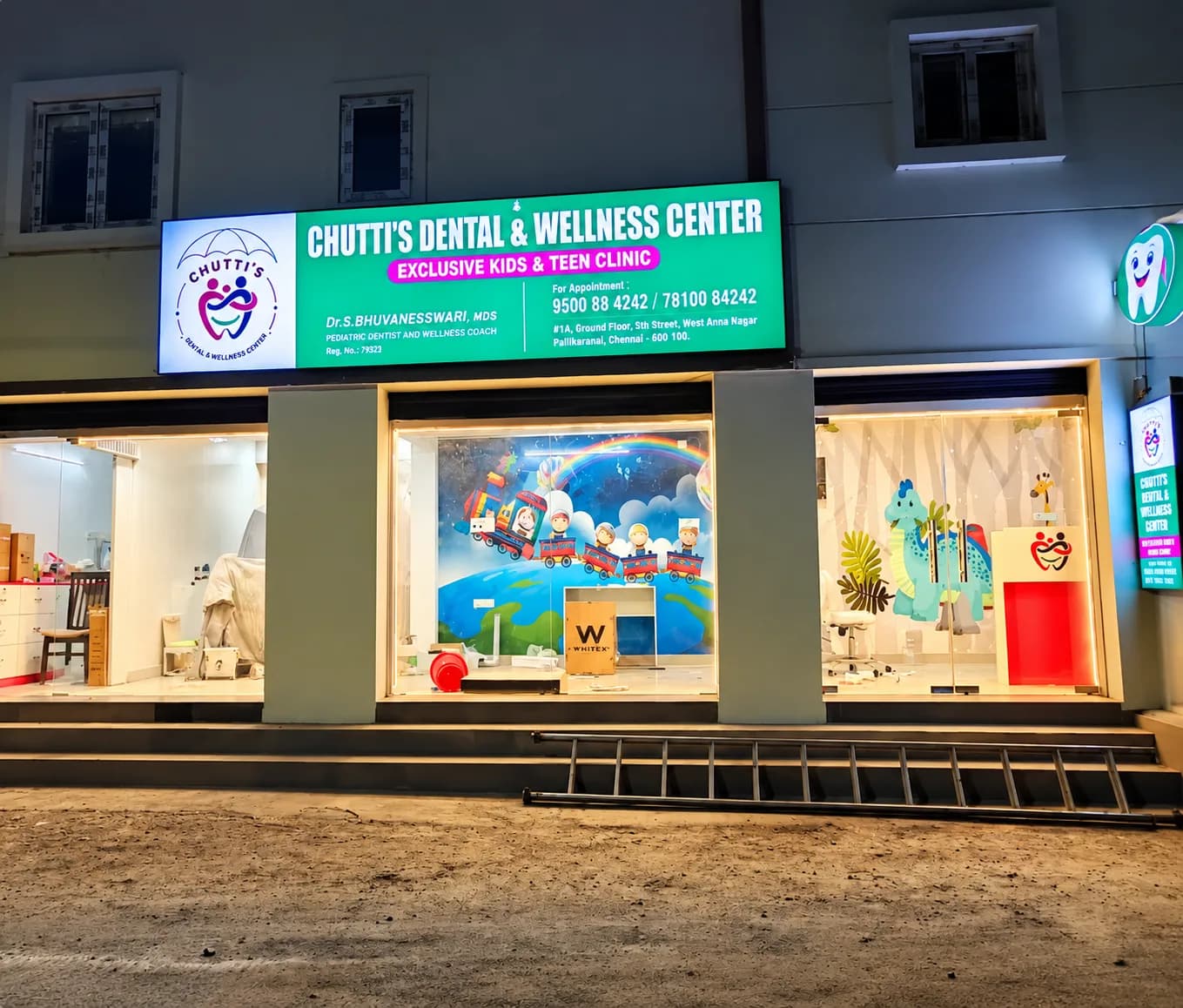
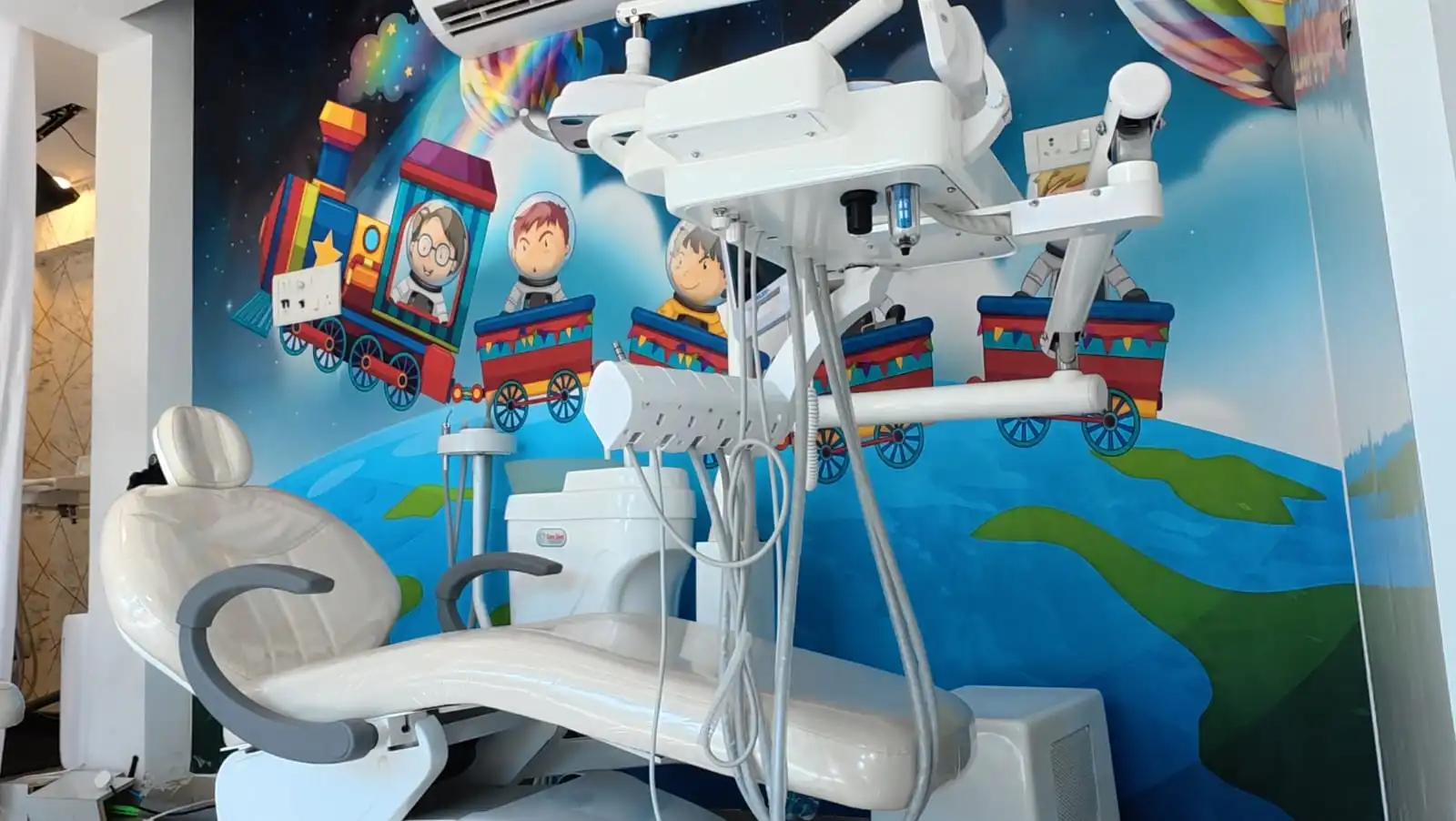
- Show them the clinic photos below so the place feels familiar before they arrive
- Don’t promise a treat “if you’re brave” before the visit — praise afterwards instead
- If you have worries about your child’s behaviour, share them with the doctor privately rather than in front of your child
- A few tears or wriggles are normal for a first visit — the team is used to it and there is no pressure
- After the visit, there’s a little surprise waiting for your child
What to bring
- Your child’s medical history — any conditions, allergies and current medicines
- Any previous dental records or X-rays
- Your list of questions
- A favourite toy or comfort item
- For babies: notes on feeding patterns (breast or bottle, night feeds), plus a spare set of clothes
On the day
What happens at the first visit?
Adapted to your child’s age and comfort, so not every visit follows exactly this order.
1.Arrive and settle in
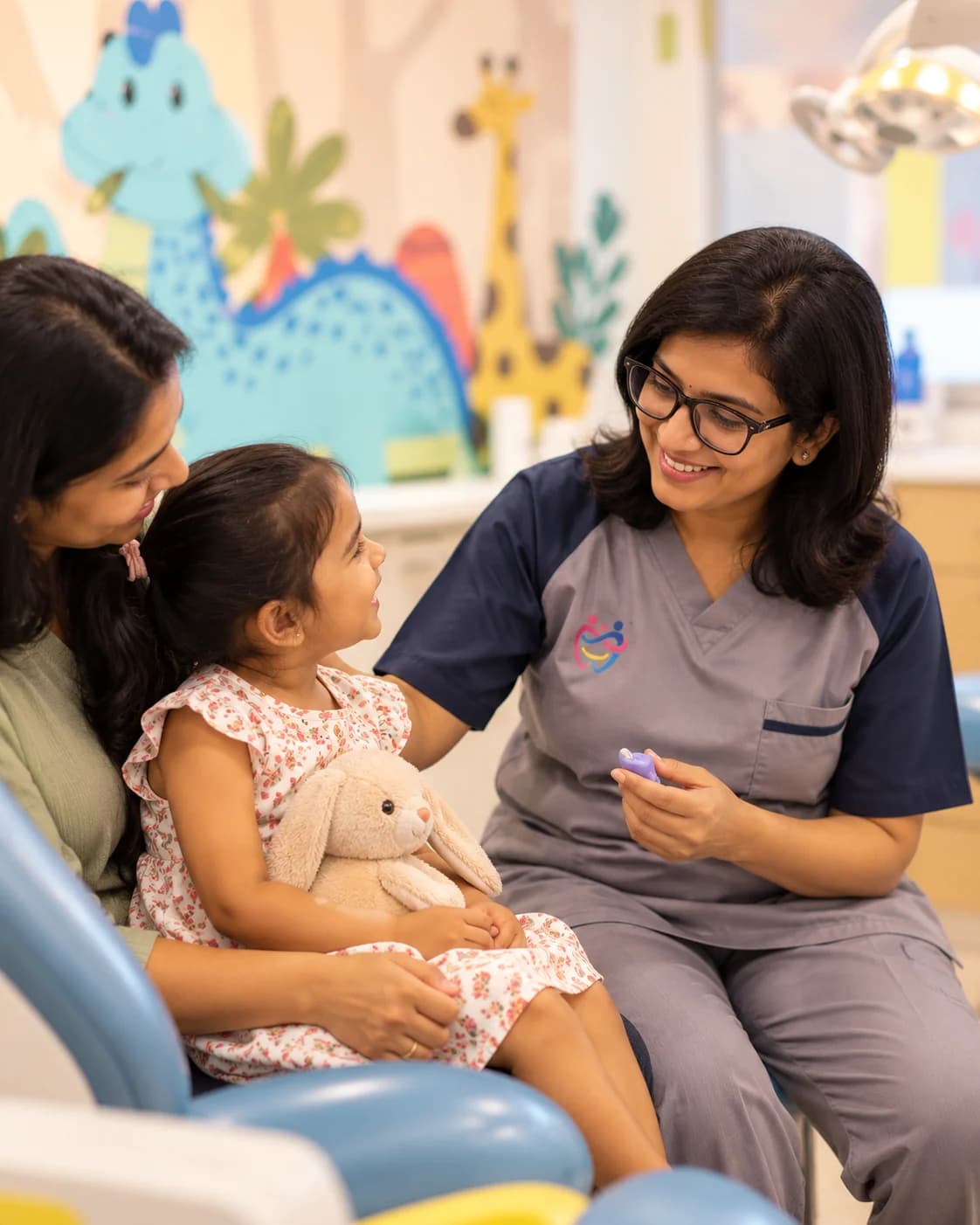
Time for your child to take in the clinic at their own pace. Very young children can sit on a parent’s lap for the whole visit.
2.A gentle check
Teeth, gums, jaw and bite, and how they are developing for your child’s age. Parents stay in the room throughout.
3.A cavity-risk check
Caries-Risk Assessment (CRA): how likely your child is to get cavities, so the prevention plan fits them — not a generic handout.
4.Cleaning and fluoride, if needed
Professional cleaning, then fluoride if indicated. X-rays only if there is a clinical reason to take them.
5.A sit-down with you
Findings, brushing, feeding and diet, habits like thumb-sucking, and a prevention plan. The next check-up is planned — usually every six months, adjusted to your child’s risk.


For your child
Let them see Chutti’s first.
Looking at the clinic together before the visit helps the place feel familiar.
Watch the clinic videos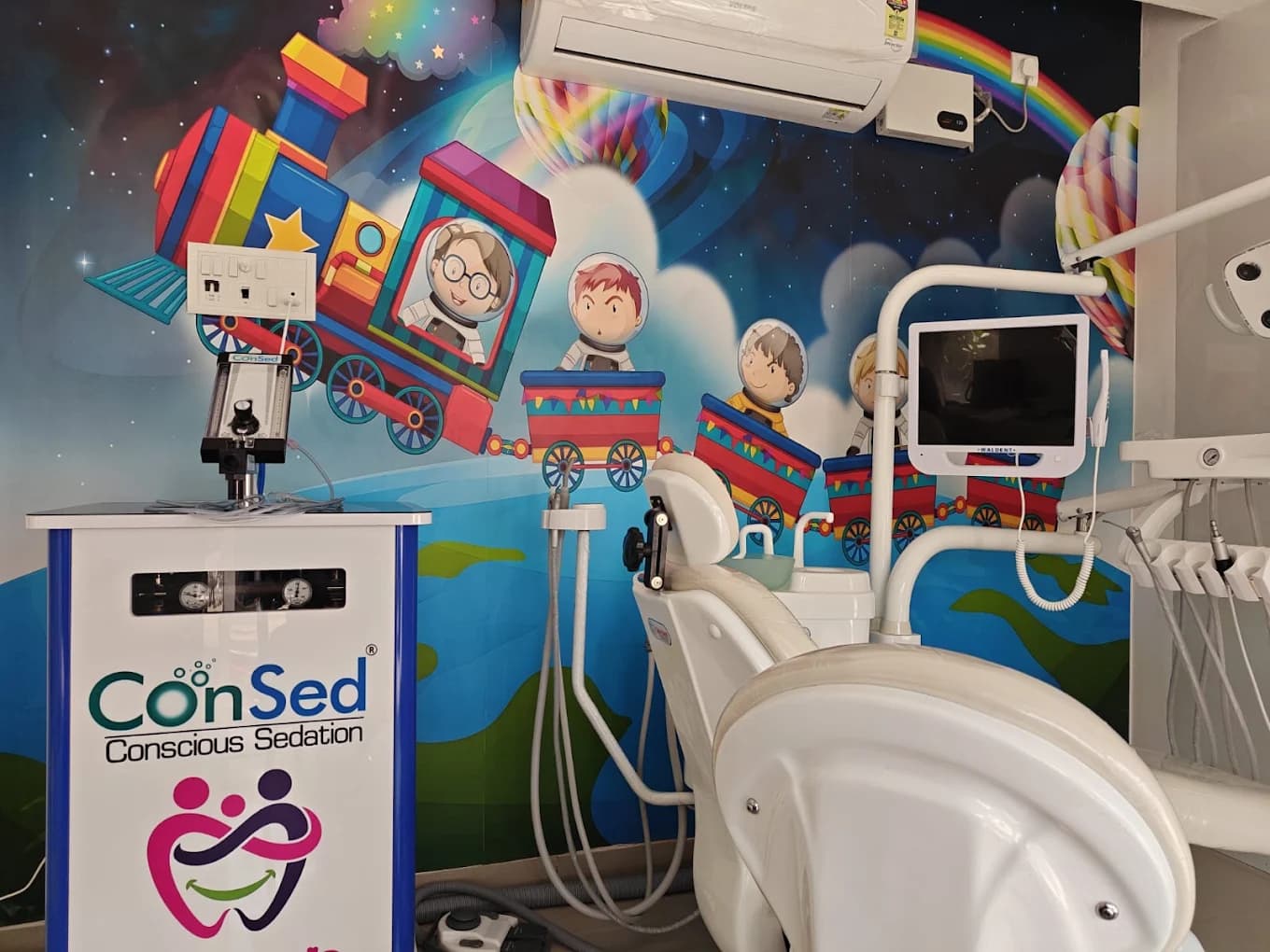
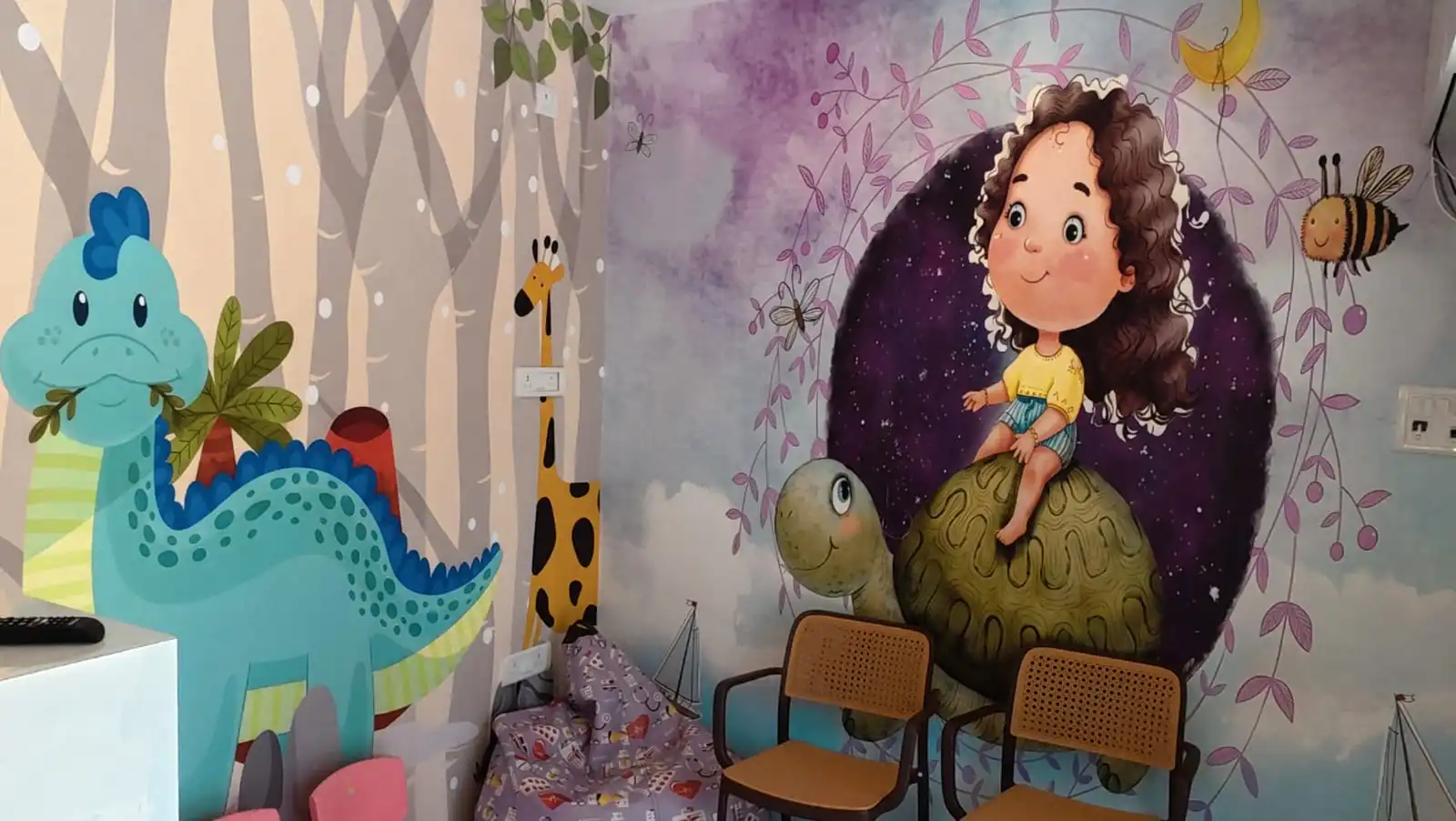
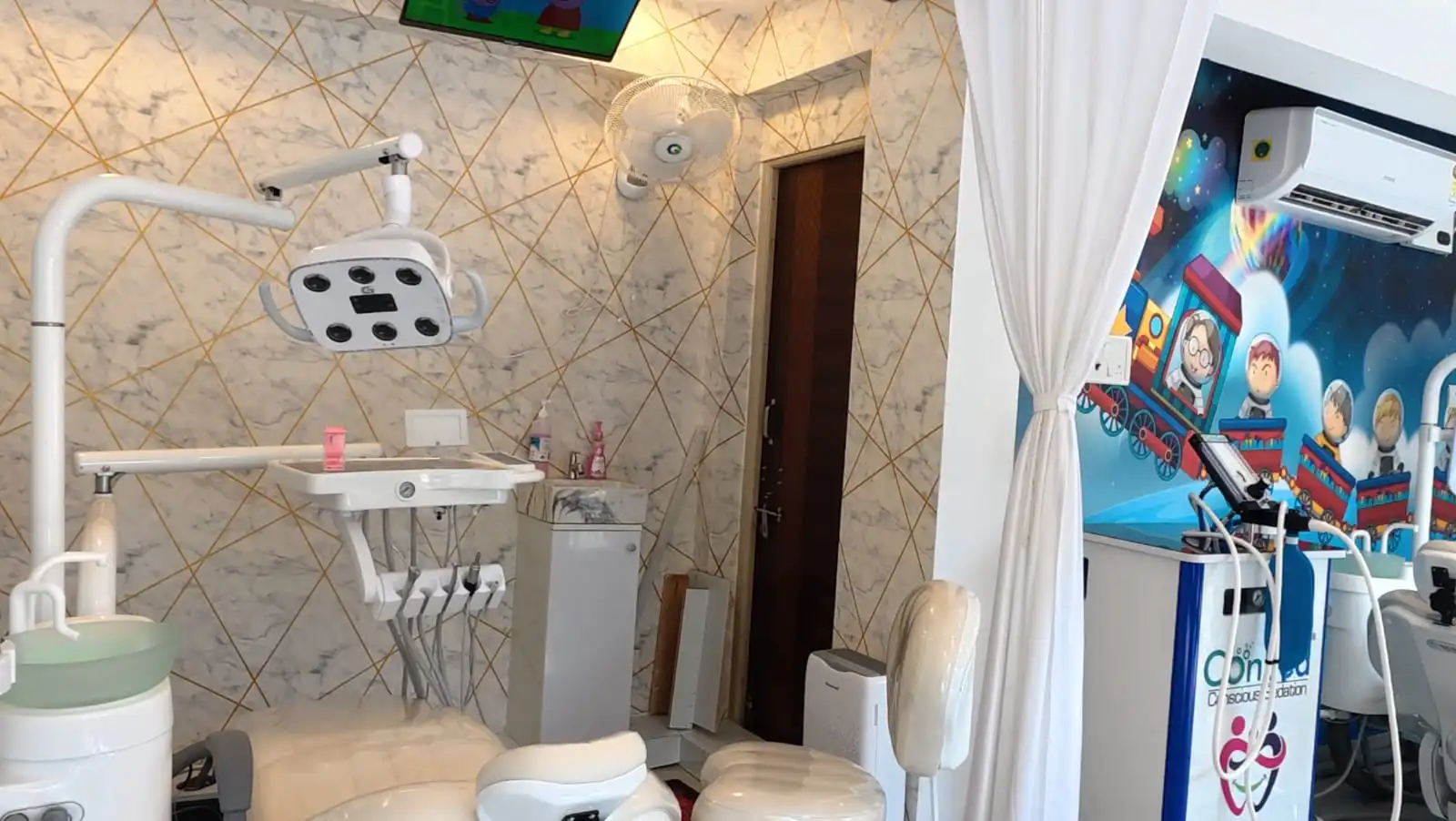
Questions
What parents often ask
- A pediatric dentist (pedodontist) has completed an MDS — three years of postgraduate training beyond general dentistry — focused specifically on children's dental disease, how teeth and jaws grow, and how to manage children's fears and behaviour during treatment. Dr. Bhuvanesswari's training and years in pediatric practice shape how the whole Chutti's team works: we adjust our language, pace and technique to your child's age and temperament, and we monitor how their teeth and jaw are developing over time, not just what needs fixing today.
- By the first birthday, or within six months of the first tooth appearing — whichever comes first. This is the guidance from the American Academy of Pediatric Dentistry (AAPD), which Dr. Bhuvanesswari's approach follows. If your child is older and has never seen a dentist, that is fine — come now. There is no judgement, only a plan for what to do from here.
- Yes. Baby teeth are not just temporary placeholders. They hold space for adult teeth, help your child chew and speak clearly, and some stay in place until age 10–12. An untreated cavity in a baby tooth can become painful quickly, spread to neighbouring teeth, and even damage the adult tooth forming underneath it. Treating a cavity in a baby tooth early is almost always simpler, less uncomfortable and less expensive than dealing with it after it has progressed.
- Root canal treatment for children's teeth (called pulp therapy) is not the same experience as an adult root canal. We explain everything before it happens — to you and to your child, in simple words. Your child can sit on your lap or stay close to you throughout. Many parents who arrive worried find that the child handled it much better than expected. The reviews on this clinic reflect that consistently. Laughing gas is available if your child needs extra help feeling calm, after a clinical assessment.
- Start by not rushing anything. We use Tell-Show-Do: we tell your child what is going to happen in simple words, shows them the instrument or step, and then does it — so nothing comes as a surprise. The visit is paced by your child. Some children need two or three visits just to feel comfortable before any treatment starts, and that is completely fine. A few tears or wriggles are normal; the team is used to it and there is no pressure. Parents are always welcome to stay in the room.
- Laughing gas (nitrous oxide) is breathed through a small, comfortable nose mask. It makes your child feel calm and relaxed while staying completely awake — they can hear you, respond to the doctor and follow instructions throughout. The effect wears off within a few minutes of removing the mask. Dr. Bhuvanesswari and her team evaluate each child individually and suggest laughing gas only when it is appropriate for them — it is not used for every anxious child. We will explain what your child will feel before it is used.
- Yes. Dr. Bhuvanesswari and her team have experience with children who need extra time, a modified environment, or care planned around their medical history and developmental needs. Please share as much as you can in the "Tell us about your child" field when you book — triggers, sensitivities to sound or light, what helps, what doesn't, a comfort object, your child's communication style. The more we know, the better we can prepare. Dr. Bhuvanesswari and her team review every note before the appointment.
- Clear aligners are available for children of any age who clinically need them — not only teenagers. The right time depends on your child's dental development and what kind of movement is needed, not a fixed number. Dr. Bhuvanesswari and her team will assess your child and tell you whether now is the right time, or whether it makes sense to wait and what to watch for in the meantime.
- Aligners are a series of clear, custom-made removable trays. Each tray is worn for about one to two weeks, then replaced with the next one in the series, gradually moving the teeth into the planned position. They are removed for eating, brushing and sports. Braces are fixed metal brackets bonded to the teeth, adjusted at regular visits. They are often more effective for complex movements but are more visible and require more care around eating and cleaning. We will tell you which option is right for your child's specific situation at the aligner consultation.
- No. Chutti's Dental & Wellness Center is dedicated to children from birth to 18. Every part of the clinic — the interiors, the approach, the training — is designed for children. We do not treat adults.
- Act quickly and WhatsApp or call for a same-day appointment. If it is a permanent tooth: pick it up by the crown (white part), not the root. Do not scrub it. Store it in cold milk or gently in the child's cheek, and come immediately — time matters. If it is a baby tooth: do not put it back in (this can damage the adult tooth underneath). Apply gentle pressure if the gum is bleeding. Bring the tooth with you.
- Yes — for dental injuries and sudden toothache, WhatsApp or call us for a same-day appointment. Same-day slots are arranged through WhatsApp or phone, not through the online booking form (which is for planned visits).
- Yes. Parents are welcome in the treatment room throughout. For young children, we often work with the child sitting on the parent's lap. We will let you know if we ever need you to step back briefly for a specific reason, but in general, your presence is encouraged.
- We accept UPI, card payments and cash.
- Chutti's Dental & Wellness Center is at Plot No 1A, Gandhi Nagar 5th Street, West Anna Nagar, Pallikaranai, Chennai, Tamil Nadu 600100. A useful landmark is near DAV School, Pallikaranai. We are open all days — including weekends and public holidays — from 11 AM to 8 PM, by appointment.
Ready for the first visit?
Book with Chutti’s at a time that suits your child, or WhatsApp us with any questions first.
For treatment costs, WhatsApp or call us — our team will give you an estimate after seeing your child.
- All days, 11 AM – 8 PMBy appointment
- Pallikaranai, ChennaiNear DAV School, Pallikaranai